





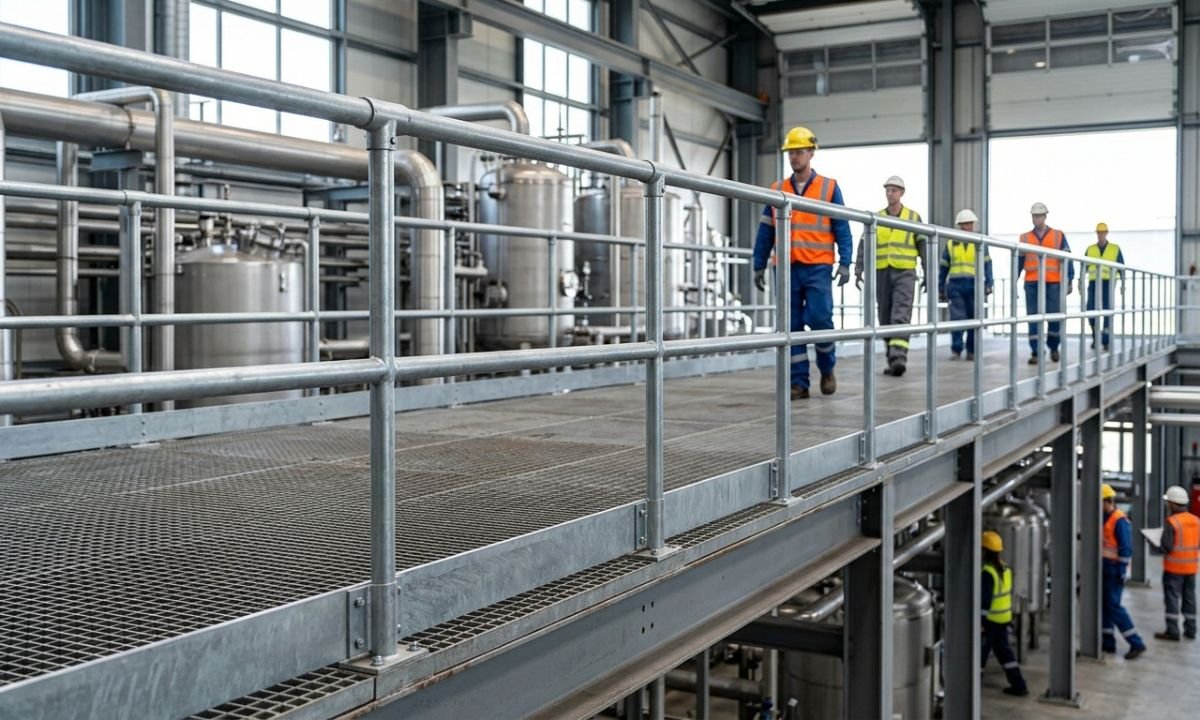
A tool slipping from a mezzanine may seem like a minor incident until you consider where it lands. On a busy industrial site, a wrench, pipe fitting, or piece of debris can become a serious falling-object hazard in seconds. That is why simple safety components matter. Intrepid Industries, for example, manufactures OSHA-compliant industrial safety products including self-closing safety gates, toeboards, safety hooks, and custom molded polyurethane components designed for demanding environments such as refineries, warehouses, manufacturing facilities, and construction sites.
So, what is a toe board, exactly? A toeboard is a protective barrier installed along the exposed edge of an elevated walking or working surface. Its job is straightforward: help keep tools, materials, equipment, and debris from sliding or being kicked over the edge and striking someone below. It is a small piece of a larger fall protection system, but it can prevent a surprisingly serious problem.
If you manage a workplace with elevated platforms, mezzanines, catwalks, scaffolds, or exposed edges, understanding toeboard requirements is worth the few minutes it takes. Let’s break it down.
What Is a Toeboard?
A toeboard is a vertical barrier installed at the bottom of a guardrail system or along an exposed platform edge. It creates a physical stop between the walking surface and the edge.
Think of it as a kick plate for an elevated platform.
A worker may accidentally kick a loose bolt. A box might slide across a slightly uneven surface. A hand tool could roll toward the edge. Without a barrier, that object can fall to a lower level.
A properly installed toeboard helps stop those objects before they leave the platform.
Toeboards are commonly found on:
- Elevated work platforms
- Industrial mezzanines
- Catwalks
- Scaffolds
- Roof edges
- Loading platforms
- Walkways
- Stair and ladder access areas
- Construction platforms
- Manufacturing facilities
- Refineries and chemical plants
They are particularly important anywhere people work above other employees, visitors, equipment, vehicles, or occupied areas.
How Tall Should a Toeboard Be?
Under OSHA’s general requirements for falling-object protection, a toeboard must have a minimum vertical height of 3.5 inches (9 cm) measured from the walking or working surface to the top edge of the toeboard.
That answers the common question, “how tall should a toeboard be?“
The minimum OSHA height is 3.5 inches.
OSHA also specifies that the clearance between the bottom of the toeboard and the walking or working surface must not exceed 1/4 inch. The toeboard must be solid or have openings no greater than 1 inch at their greatest dimension.
There is an important detail here, though. Minimum does not always mean ideal for every application.
If tools, equipment, or materials are stored higher than the top of the toeboard, additional protection may be necessary. OSHA requires additional paneling or screening in situations where the standard toeboard alone cannot adequately protect workers below.
In other words, don’t simply measure 3.5 inches, install a strip of material, and assume the job is finished. Look at what is actually happening on the platform.
OSHA Toeboard Requirements at a Glance
| Requirement | OSHA guideline |
|---|---|
| Minimum height | 3.5 inches |
| Maximum clearance above walking surface | 1/4 inch |
| Maximum opening size | 1 inch |
| Minimum force resistance | 50 pounds |
| Purpose | Help prevent falling objects from reaching lower levels |
| Additional protection | Required when objects are piled above the toeboard |
OSHA’s general industry standard states that toeboards used for falling-object protection must withstand a force of at least 50 pounds applied downward or outward at any point along the toeboard.
Construction requirements under OSHA’s 1926.502 also specify a minimum 3.5-inch vertical height, no more than 1/4-inch clearance above the working surface, openings no greater than 1 inch, and the ability to withstand 50 pounds of force.
That’s why material choice and installation quality matter just as much as height.
Why Are Toeboards Important?
It is easy to overlook a toeboard because it isn’t as visually impressive as a guardrail or safety gate. But workplace safety is often about the details people barely notice.
A guardrail may prevent a worker from walking directly off a platform. A toeboard addresses a different problem: objects going over the edge.
Consider a refinery platform with employees working several feet above ground level. Someone drops a wrench. If the wrench rolls toward an open edge, a properly installed toeboard can stop it.
Now imagine that same wrench landing on a worker below.
That is the difference between a minor inconvenience and a potentially serious workplace incident.
Toeboards Help Control Falling-Object Hazards
Toeboards are primarily designed to help prevent tools, debris, and other objects from falling from elevated surfaces.
They can also provide a useful visual and physical boundary around the edge of a platform. In busy work areas, that extra barrier can make a difference.
They Work as Part of a Larger System
A toeboard should not be treated as a replacement for a complete fall protection system.
Guardrails, self-closing safety gates, proper access controls, housekeeping, personal protective equipment, and other controls may all have a role depending on the workplace.
Good safety design works in layers.
One barrier catches what another layer doesn’t.
Where Are Toeboards Commonly Used?
Toeboards have applications across many industries, but some environments naturally present more falling-object risks than others.
Refineries and Chemical Plants
Industrial processing facilities often have multiple elevated platforms, pipes, walkways, ladders, and maintenance areas.
Workers may carry tools and replacement components onto these platforms. A corrosion-resistant toeboard can provide added protection in areas exposed to chemicals, moisture, or harsh weather.
Warehouses
Modern warehouses frequently use mezzanines, elevated storage platforms, conveyor systems, and maintenance walkways.
A dropped object can create a hazard for employees working at floor level. Toeboards help keep loose materials contained on elevated surfaces.
Construction Sites
Construction creates an especially challenging environment because conditions change constantly.
Tools and materials are moved, platforms are modified, and different crews may work above and below one another. Toeboards can form part of a broader falling-object protection strategy.
Manufacturing Facilities
Manufacturing floors often contain machinery, pedestrian routes, elevated platforms, and maintenance areas.
A small object falling into the wrong place can damage equipment or injure a worker. Proper edge protection helps reduce that exposure.
Toeboard vs. Guardrail: What’s the Difference?
These two components are sometimes confused because they can be installed together, but they serve different purposes.
| Feature | Toeboard | Guardrail |
|---|---|---|
| Primary purpose | Helps prevent objects from falling | Helps prevent workers from falling |
| Typical position | At the bottom of an exposed edge | Around the perimeter of an elevated area |
| Protects against | Tools, debris, materials | Worker falls |
| Typical height | Minimum 3.5 inches under OSHA falling-object provisions | Much taller, depending on applicable standard |
| Works independently? | Usually part of a broader system | Usually part of a broader fall protection system |
The simplest way to remember it is this: guardrails protect people at the edge, while toeboards help protect people below from things going over the edge.
Of course, real-world safety systems overlap. The exact requirements depend on the application and the standard that applies.
What Materials Are Used for Toeboards?
Toeboards can be manufactured from several materials, including metal, wood, and engineered polymers.
The right choice depends on the environment.
Steel can offer strength, but corrosion may become an issue in certain outdoor, marine, or chemical environments. Wood can be practical in some construction applications, but it may degrade when exposed to moisture and harsh conditions.
Polyurethane is another option worth considering for demanding industrial environments.
Intrepid Industries manufactures toeboard components from rigid polyurethane designed to resist corrosion, weather exposure, and chemical conditions. Its T5 Toeboard Links are designed to enclose unwanted openings, gaps, and penetrations around grating and deck plate.
That’s useful in facilities where traditional materials may require more maintenance.
Why Intrepid Industries Is Worth Considering
Industrial safety products need to do more than look good on a specification sheet. They need to survive the environment where they’re installed.
Intrepid Industries manufactures industrial safety products for applications including refineries, chemical facilities, offshore environments, manufacturing operations, and other demanding workplaces. Its product range includes self-closing safety gates, toeboards, safety hooks, PPE accessories, and custom polyurethane components.
Its Universal Gravity-Closing Safety Gate is designed for areas such as ladder openings, mezzanines, catwalks, and elevated platforms. The company says the gate uses a gravity-closing design rather than a traditional spring mechanism and is manufactured from proprietary polyurethane.
Its toeboard systems take a similarly practical approach. The T5 Toeboard Links are bolt-on components designed to close gaps and openings around industrial grating without requiring welding or scaffolding for installation.
For facilities dealing with corrosion, moisture, chemicals, UV exposure, or frequent maintenance, material durability isn’t a luxury. It becomes part of the safety equation.
Toeboards Are Not Just About Compliance
Compliance matters, obviously. Nobody wants a safety inspection to reveal an avoidable deficiency.
But compliance should be viewed as the baseline rather than the entire safety strategy.
A platform can technically have a 3.5-inch toeboard and still be poorly managed if workers routinely stack boxes, pipes, or equipment above it.
That’s why regular inspections matter.
Ask practical questions:
- Is the toeboard securely attached?
- Is there excessive clearance underneath?
- Are openings within the allowed limits?
- Has corrosion weakened the material?
- Are materials stored above the top edge?
- Could objects still fall through a nearby gap?
- Is the surrounding guardrail intact?
- Are ladder and platform openings properly protected?
These questions often reveal problems that a simple measurement won’t catch.
Common Toeboard Mistakes to Avoid
Even a correctly designed toeboard can become ineffective if it’s poorly installed or maintained.
Using the Wrong Height
Installing a barrier shorter than the applicable minimum can create a compliance and safety problem.
Leaving Too Much Space Beneath It
A large gap underneath can allow tools and debris to pass through.
OSHA generally limits this clearance to 1/4 inch for the applicable falling-object provisions.
Ignoring Stored Materials
If materials are stacked above the toeboard, additional screening or paneling may be needed.
Treating a Toeboard as Fall Protection for Workers
A toeboard isn’t designed to stop a person from falling over an elevated edge. That’s the role of an appropriate guardrail, gate, or other fall protection system.
Forgetting Maintenance
Even durable safety components should be inspected. Fasteners can loosen, structures can change, and surrounding equipment can create new hazards.
How to Choose an Industrial Toeboard
Before purchasing or installing a toeboard, consider more than the dimensions.
1. Identify the hazard.
Is the main concern falling tools, debris, stored materials, or an exposed platform edge?
2. Check the applicable standard.
OSHA requirements can differ according to the type of workplace and application.
3. Measure the installation area.
Consider platform dimensions, grating, pipe penetrations, corners, and existing guardrails.
4. Consider the environment.
Chemical exposure, saltwater, sunlight, moisture, heat, and impact can all influence material selection.
5. Look at installation requirements.
A system that can be installed without extensive welding or structural modification may be useful when upgrading an existing facility.
6. Plan for inspection and maintenance.
A safety product is only useful if it remains secure and functional after installation.
Frequently Asked Questions
What is a toeboard used for?
A toeboard is used to help prevent tools, debris, equipment, and other objects from falling from an elevated walking or working surface. It is commonly installed along the bottom edge of guardrail systems and elevated platforms.
How tall should a toeboard be?
Under OSHA’s general falling-object protection requirements, a toeboard must be at least 3.5 inches high, measured from the walking or working surface to its top edge. Certain applications can have different requirements, so the applicable standard should always be checked.
How much clearance can be under a toeboard?
OSHA’s general industry requirements specify no more than 1/4 inch of clearance above the walking or working surface for toeboards used for falling-object protection.
Can a toeboard stop a person from falling?
No. A toeboard is primarily intended to help prevent objects from falling from elevated surfaces. Worker fall protection generally requires an appropriate guardrail system, safety gate, personal fall protection system, or another control suitable for the specific hazard.
Are toeboards required on every platform?
Not necessarily in every situation. Requirements depend on the workplace, platform, hazard, and applicable safety standard. Where falling objects could endanger workers below, OSHA has specific requirements for toeboards and additional protection.
What happens if materials are stacked higher than a toeboard?
Additional protection may be necessary. OSHA requires paneling or screening when tools, equipment, or materials are piled higher than the top edge of the toeboard and the situation creates a falling-object hazard.
Are polyurethane toeboards suitable for industrial environments?
Polyurethane can be a useful option in demanding environments because certain formulations can resist corrosion, moisture, chemicals, UV exposure, and other forms of environmental wear. The material and product should still be evaluated against the specific application and applicable safety requirements.
Final Thoughts
So, what is a toeboard? At its core, it’s a simple barrier designed to stop objects from leaving an elevated working surface and becoming a hazard below.
And how tall should a toeboard be? Under OSHA’s general falling-object protection requirements, the answer is at least 3.5 inches, with additional requirements covering clearance, openings, strength, and situations where materials are stored higher than the toeboard.
The bigger lesson is that workplace safety rarely comes down to one product. A well-designed facility combines guardrails, self-closing safety gates, toeboards, good housekeeping, proper access controls, inspections, and worker awareness.
Honestly, the smallest safety components are sometimes the ones that prevent the biggest headaches.
For facilities such as refineries, warehouses, manufacturing plants, and construction sites, choosing durable safety hardware and maintaining it properly can make everyday work safer while supporting regulatory compliance. The question worth asking isn’t simply whether a toeboard is installed. It’s whether the entire edge protection system is actually doing the job it was designed to do.